


Concrete Joint Sealing for Car Parks, Yards and Slabs
Open concrete joints let in water, grit and fuel, and the slab edges soon start to break. Our team provides concrete joint sealing for commercial, industrial and infrastructure sites, using sealants chosen for the traffic each joint takes.
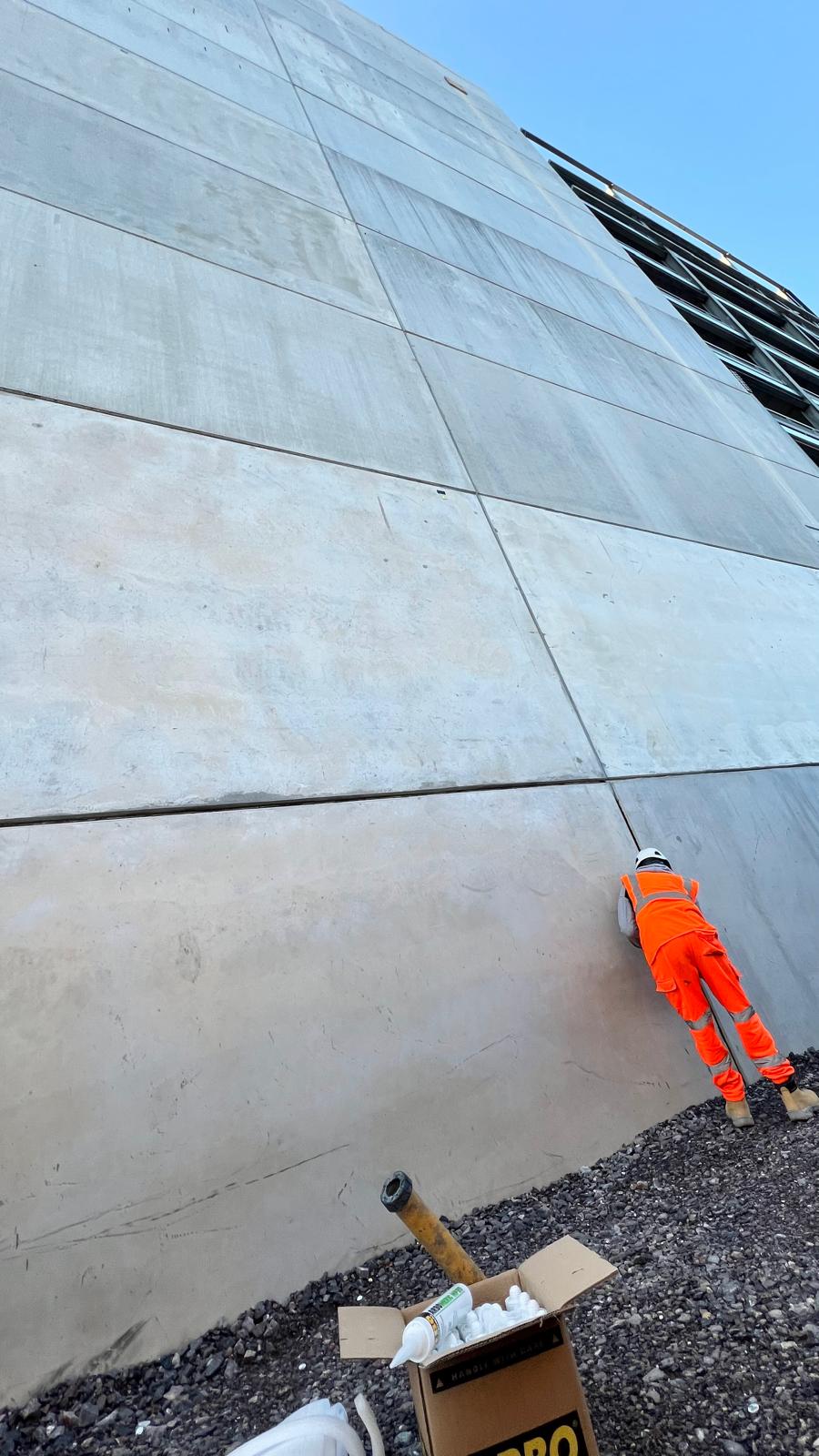
Photo: concrete joint sealing at a development in Dagenham, east London.
Concrete joints mastic that keeps the slab in one piece
Concrete is laid in bays with joints between them so it can shrink, expand and move without cracking at random. Those joints are a weak point: if they are left open, or the old concrete joint sealant has perished, water gets underneath, stones jam into the gap and wheel loads chip the arrises away.
A properly sealed joint keeps the joint faces clean, stops water reaching the sub-base and lets the bays move freely. On busy yards and car parks that can add years to the life of the concrete.
The concrete joints we seal
Our concrete joints mastic work covers:
Saw-cut joints
Contraction joints cut into slabs to control cracking, sealed once the slab has cured.
Construction joints
Day joints between pours, where the concrete bays meet.
Expansion and isolation joints
Full-depth joints around columns, walls, drainage and between slabs.
Wall and upstand joints
Vertical concrete joints in retaining walls, car park walls and upstands.
Car park joint sealing, yards and hardstandings
Car park joint sealing is a big part of our concrete work, from surface car parks to wall joints on multi-storey structures. We also seal service yards, loading bays, hardstandings, ramps and external concrete paving at retail, logistics and public sites.
Pioneer Sealants also seals airport runways and concrete slabs at airports, where joints have to stand up to heavy loads, jet fuel and constant weather. One recent example on our gallery is concrete joint sealing at a development in Dagenham, east London.
How we work: cut out, clean, back and seal
A concrete joint is only as good as its preparation.
Cut out
Old sealant and debris removed, with joints re-cut or widened where the profile is wrong.
Clean
Joint faces wire-brushed or ground, then vacuumed or blown clean and left dry.
Back and prime
Backer rod or bond breaker tape at the correct depth, primer where the product needs it.
Seal
Sealant gunned or poured, tooled flush or slightly recessed so wheels do not pull it out.
Choosing a concrete joint sealant
Trafficked concrete needs a tough, elastic sealant. We use polyurethane joint sealant for most car parks and yards, polysulphide where fuel and oil resistance matter, and modified polymer sealants for vertical concrete. Silicone sealant has its place on some flat floor joints.
We use and apply Sika, Arbo, Tremco and Fosroc products. As concrete joint sealing contractors we follow the engineer’s specification where there is one, or recommend a product to suit the joint, the traffic and the weather.
Keeping your site open while we work
Car parks and yards rarely close for long. We phase the work bay by bay, work evenings or weekends where needed, and agree cones, barriers and traffic management with your site team. RAMS are provided before we start.
Insured & pre-qualified
For homeowners, builders and main contractors.
- £10m Employer’s LiabilityInsurance cover
- £5m Public Liability & Professional IndemnityInsurance cover
- Constructionline Silver member

- NVQ Level 2Sealant Applicator
Over 20 years in construction
Products we use
Sealants and adhesives we use on site.








Brand names and logos are trademarks of their respective owners and are shown to identify products we use. No endorsement is implied.
Concrete joint types, sealants and maintenance
External concrete is laid in bays, and every bay joint needs a sealant that keeps water, grit and de-icing salts out while the slabs move with the seasons. Contraction joints are sawn or formed to control cracking, expansion joints allow the slabs to grow in hot weather, and isolation joints separate the slab from kerbs, drainage channels, walls and columns. Each one is sealed to a different width and depth.
In car parks, service yards and hardstandings we normally use polyurethane or polysulphide joint sealants, chosen for traffic, fuel and oil resistance where vehicles stand. Joints on decks and ramps may need faster-curing grades so that a level can reopen quickly.
- Old sealant ploughed or cut out, and joints re-sawn where the edges are ragged
- Joint faces grit blasted or wire brushed, blown clean and dried
- Closed-cell backing rod set to the correct depth, then primer
- Sealant finished slightly below the surface so wheels and ploughs do not pull it out
Sealed concrete joints should be checked every year or two. Catching a failed joint early stops water softening the sub-base and saves a slab repair later, and planned resealing can be booked bay by bay so a yard or car park never has to close completely. For internal floors see slab joint sealing, and for airside and heavy pavement work see runway and pavement joints. Our expansion joint page covers walls and structures.
Our work, reviews and related services
Rated 5.0 from 15 Google reviews. Homeowners, landlords and contractors review our sealant work on Google, and we are always happy to share photos of similar jobs before you book.
Related services: slab and floor joint sealing, runway and pavement joint sealing, expansion and movement joint sealing, structural movement joint sealing.
Concrete joint sealing: common questions
How long before vehicles can drive on resealed joints?
It depends on the sealant and the temperature. Many polyurethane joint sealants can take light traffic within a day; we confirm cure times before we start.
Can you seal joints in wet weather?
Joint faces must be dry for the sealant to bond, so we plan around the forecast and protect joints where we can.
Do you repair broken joint edges too?
We renew the sealant. Where arrises are badly broken we will tell you before we quote, so the edges can be repaired first.
Which areas do your concrete joint sealing contractors cover?
London, the South East, the Midlands, the East of England and the South, with larger infrastructure work further afield.
Concrete joints breaking up or letting water in?
Send a site plan or photos to office@pioneersealants.co.uk, call 01234 607 252 or WhatsApp us, and our team will plan the right fix.
- Opening hours
- Monday – Friday8:00am – 6:30pm
- Saturday9:00am – 4:00pm
- SundayClosed