

On a glazed or clad building, the sealant joints are small, but they do a big job. They keep wind-driven rain out and let the panels and glass move with the weather. When curtain wall sealant starts to fail, the first you usually hear about it is a stain on a ceiling tile or a puddle on a window board, and by then the water has been getting in for a while.
We’re Pioneer Sealants Ltd, Bedford-based specialist sealant applicators with over 20 years in construction behind the company. We do façade and curtain wall sealant work for main contractors, property managers and building owners across London, the South East, the Midlands and East Anglia. This guide covers what to look for, why seals fail, and what a proper re-seal involves.
Signs your façade sealant is failing
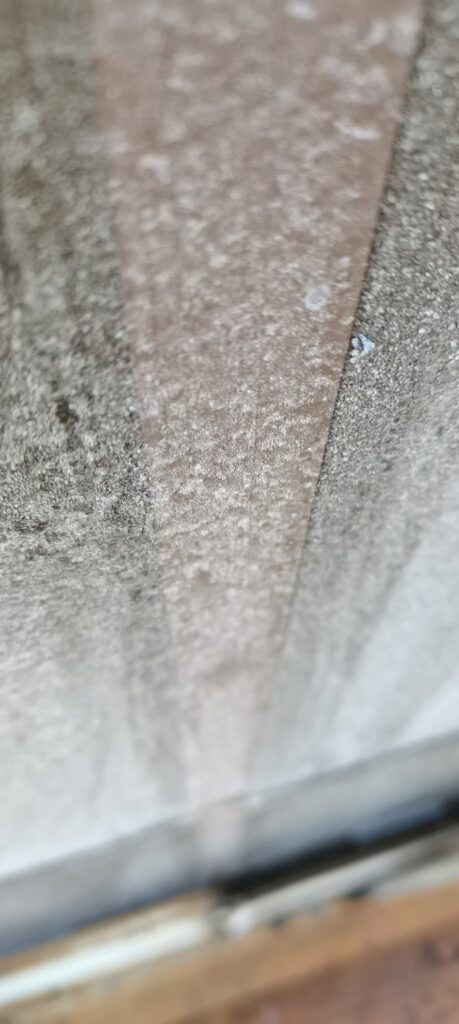
A walk round the building, inside and out, will show you most of these.
- Sealant pulling away from one side. A thin dark gap along the edge of the bead means it has lost its grip on the frame, glass or stone. This is called adhesive failure, and water goes straight in behind it.
- Splitting down the middle. If the bead has torn through its own centre, the joint has moved more than that sealant could cope with, or the bead was too thin.
- Hard, cracked or chalky sealant. Good façade sealant stays rubbery. If it feels like plastic or is crazed with fine cracks, it’s finished.
- Gaps and missing sections. Corners, transom-to-mullion junctions and the joint where glazing meets stone or brick are the usual places for bits to drop out.
- Staining around the joints. Dark streaks running down pale stone or render beside a joint can come from dirt held on old or unsuitable sealant. It’s one reason non-staining silicone is specified next to natural stone.
- Leaks, draughts and whistling inside. Damp at window heads and sills, cold spots near the frame, or a whistle on windy days often point back to a failed perimeter seal.
Worth knowing: the rubber gaskets that hold glass in many curtain wall systems aren’t sealant. If those have perished, that’s usually one for the glazing installer.
Why curtain wall and façade joints fail
Three-sided adhesion. A movement joint should be stuck to two sides only. If there’s no backer rod or bond breaker tape, the sealant bonds to the back of the joint as well, can’t stretch, and tears.
The wrong product for the job. Silicone, polyurethane, polysulphide and modified polymer sealants all behave differently. Some don’t suit natural stone, some won’t take much movement, and some aren’t compatible with what was there before.
Poor preparation. Dust, old sealant residue, damp or a missing primer where the manufacturer calls for one will all stop a seal from bonding properly.
Joint size. A joint that’s too narrow or too shallow leaves the sealant with nowhere to go when the building moves.
Age and weather. Sun, frost and rain wear every sealant down in the end.
What a proper re-seal involves

Replacing façade sealant isn’t just running a new bead over the old one. Done properly, facade joint sealing goes like this:
- Look at the joints first. We check the joint widths, what’s failed and how, and what the substrates are (aluminium, glass, stone, brick, render or cladding panels). If there’s an original specification, we want to see it.
- Cut out the old sealant completely and clean the joint back to sound, dry surfaces.
- Prime where the manufacturer requires it, which is often the case on stone, concrete and some coated metals.
- Fit a backer rod or bond breaker so the new seal bonds to two sides and has the right depth.
- Apply and tool the new sealant to a neat, consistent profile, in a colour that matches the frames or façade.
- Check it. Every corner and junction needs closing off properly, not just the straight runs.
On product choice, we use and apply products from brands such as Arbo, Sika, Dow (DOWSIL) and Tremco CPG, matched to the substrate and the movement the joint needs to take. At the new City of London law courts at Salisbury Square, where we’re currently sealing the external window frame perimeters between the stone façade and the frames, we’re using Arbo Arbosil XL1099, a non-staining silicone chosen because it sits against natural stone. You can read more on our Salisbury Square project page.
Structural silicone joints, the ones that actually help hold glass in place, are a different matter. If there’s any doubt about those, the façade designer or system supplier needs to be involved before anything gets cut out.
Access on occupied and city-centre buildings

Most façade sealant work happens at height, so access is a big part of the plan. That might be a boom lift, scaffold or a mobile tower. We’re IPAF trained, work to the site’s RAMS and permits, and can work out of hours where a building is occupied or the street is busy. Every job is priced, planned and managed by Pioneer Sealants from start to finish, so what we quote is what we deliver.
We’ve worked for main contractors including Kier, Berkeley and Vistry, we hold Constructionline Silver, and we carry £10m employer’s liability and £5m public liability insurance.
Curtain wall sealant FAQ
How long does façade sealant last?
It depends on the product, the joint design and how exposed the elevation is. Go by the signs above rather than age alone.
Can you just seal over the old sealant?
We don’t recommend it. New sealant won’t bond reliably to failed mastic, so the leak usually comes back. The old seal needs cutting out.
Do you cover London?
Yes, regularly, including the City. See our London mastic and sealant contractor page.
Get your façade joints looked at
If you’ve got leaks at window heads, sealant coming away from the frames, or a façade that’s simply due a re-seal, send us a few photos and tell us where the building is. We’ll tell you honestly what’s needed. Call 01234 607 252, WhatsApp 07757 772 880, email office@pioneersealants.co.uk or use our contact page. We’re open Monday to Friday 8:00 to 18:30 and Saturday 9:00 to 16:00.
Need a hand? Pioneer Sealants can do this for you. See our façade and curtain wall sealing, commercial mastic contractor, expansion and movement joint sealing pages, or contact our team.
Insured & pre-qualified
For homeowners, builders and main contractors.
- £10m Employer’s LiabilityInsurance cover
- £5m Public Liability & Professional IndemnityInsurance cover
- Constructionline Silver member

- NVQ Level 2Sealant Applicator
Over 20 years in construction
Products we use
Sealants and adhesives we use on site.








Brand names and logos are trademarks of their respective owners and are shown to identify products we use. No endorsement is implied.
Got a joint that needs doing properly?
Call us, or send a few photos on WhatsApp for the quickest quote.
- Opening hours
- Monday – Friday8:00am – 6:30pm
- Saturday9:00am – 4:00pm
- SundayClosed